
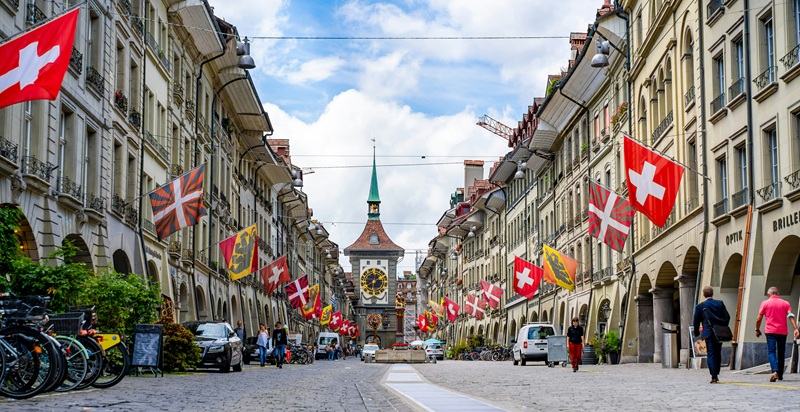
The UK and Switzerland have agreed a new free trade agreement (FTA). Here are the key points of the deal for UK businesses.
Benefits for service professionals and businesses
The government said the FTA includes “the most significant trade agreement for services concluded by the UK” which is estimated to unlock £5.2 billion a year in additional UK services exports to Switzerland “in the long run”.
UK service professionals will be able to trade in Switzerland visa-free for up to 90 days a year. This agreement was due to end in 2029 but it now been made permanent.
UK businesses will also be able to transfer staff from the UK offices to their Swiss offices for up to five years without being “subject to stringent economic needs tests”.
UK businesses will be able to access Swiss employees and service providers through a visa-free, short-term service-supplier route for up to three months.
UK lawyers will be able to provide legal advisory services in foreign and international law in Switzerland without having to requalify. This follows the existing UK-Switzerland agreement on the recognition of professional qualifications, which came into force on 8 March 2025.
Switzerland is the UK’s 6th largest services export market with over £30 billion in bilateral services trade in 2025.
UK travellers able to use Swiss eGates
In a separate agreement alongside the FTA, UK nationals will soon be able to use eGates at Swiss borders, in line with Schengen requirements. They will be able to exit via eGates at Zurich Airport from “as soon as the end of 2026”. Switzerland is also working towards allowing entry via eGates at Zurich, Geneva and Basel airports.
No mobile phone roaming charges
UK tourists and business travellers will not have to pay mobile phone roaming charges meaning they will be able to use their phones in Switzerland as part of their regular contract.
Reduced tariffs for food and drink businesses
British lamb exports will be subject to zero tariffs and UK beef steaks will get a 35% tariff reduction under Switzerland’s quota system.
For UK dairy exporters, tariffs will be cut by up to 50% on products such as milk powder.
For UK fruit and vegetable growers, tariffs will fall to as low as 0% on products including peas, carrots and broad beans.
English sparkling wine producers will receive a 34% tariff reduction, described by the government as “Switzerland’s best preferential treatment on sparkling wine”.
Digital trade
The government said the “UK has secured its most comprehensive digital chapter in an FTA”, with “commitments from both sides ensuring data will continue to flow seamlessly and freely, protected by existing data privacy safeguards in both countries”.
The deal also guarantees that “unjustified restrictions on the free flow of data cannot be introduced in the future, including data localisation requirements”.
The government said: “this will guarantee businesses in the UK will not face any unjustified restrictions on the free flow of data in the future, including costly and burdensome requirements to store their data locally in Switzerland”.
There are also agreements to facilitate paperless trading, digital payments, electronic commerce and co-operation in such as artificial intelligence, which the government said “will enable firms to trade digitally in a smooth and seamless manner”.
Creative industries
This government said the deal “delivers strong copyright protections” that “give UK creators and publishers greater certainty their work will be protected in Switzerland”.
It includes a review provision regarding the Artist Resale Right (ARR) which Christian Zimmerman, CEO of the Design and Artists Copyright Society (DACS), said “would ensure that artists are equally protected in all the major art markets in Europe if Switzerland was to adopt the right, enabling artists to share in the future success of their work”.
Life sciences and pharmaceuticals
The UK and Switzerland have agreed to maintain existing intellectual property (IP) protections for pharmaceuticals. It includes maintaining a 10-year period of regulatory data protection (RDP), consisting of eight years of data exclusivity and 10 years of market exclusivity, sometimes known together as “8+2 years” of RDP.
The FTA also commits the UK to maintaining up to five years of protection for supplementary protection certificates (SPCs), with the flexibility to increase the maximum term available. The FTA does not prevent either the UK or Switzerland from increasing their domestic periods of protection.
Innovation
The government said the UK has agreed commitments with Switzerland to “maintain and enhance our position as two global leaders in innovation” and “proactively capitalise on commercial opportunities arising from the development of innovative products and services and address any trade barriers that may arise from innovation”.
A dedicated working group of government representatives will be able to work as required with experts from industry, research and academia to share best practice, identify challenges and opportunities and respond in an agile way to drive forward innovation.
Formal recommendations can be made by the group to update the FTA so it “remains alive and responsive to challenges and opportunities for trade in innovative goods and services”.