
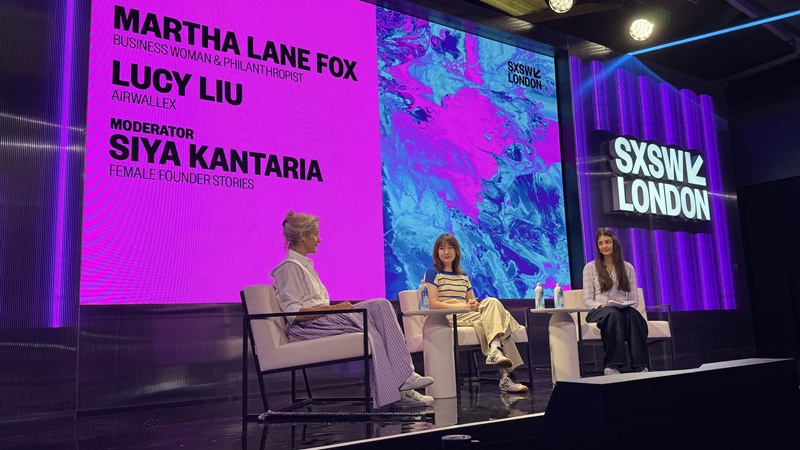
During a fascinating session at the SXSW London event, entrepreneur Martha Lane Fox shared some brilliant insights from her career and tips for building businesses.
Martha Lane Fox was the co-founder of groundbreaking travel website Lastminute.com in the 1990s. She also started karaoke business Lucky Voice, is a crossbench member of the House of Lords, president of the British Chambers of Commerce and chancellor of the Open University.
SMEWeb editor Dan Martin attended the event and outlines some of the advice and insights that she shared.
What Martha’s life changing car accident taught her about resilience
Martha Lane Fox was asked to share an example of turning a setback into an opportunity. She outlined her experience of a serious car accident in 2004 during which she suffered multiple injuries.
“My life changed forever. I went from being an able-bodied person to a disabled body person, with two years in hospital to rebuild everything.
“It was such a profound shift in my life, and I think at those moments people want to say, “did something good come out of that?” I struggle to find that. Nothing good came out of it, but the thing I will say is that it does make you really focus on the things you want to do because you have to prioritise your time so very deeply. You have to constantly be thinking about logistics, pain management stuff etc.
“What it taught me was that resilience is not some special thing that falls from on high. Anything can be turned into a moment of opportunity if you just keep going and think about it as the next step. Don’t get overwhelmed with all the other steps. It’s not some kind of incredible magic. You just have to keep going.
“It showed me that you really do just have to keep going, and if you do, then amazing opportunities can happen, and life can be rich and wonderful, but you have to keep choosing to do that.”
Why being entrepreneurial isn’t just about starting a business and why we need more entrepreneurial thinkers everywhere
“I get bugged by the idea that everybody who’s entrepreneurial has to start a business, because I just don’t think that’s true. I think we can all be entrepreneurial if we just take ownership of the problems around us. You can work in a huge organisation and be somebody that sees things and gets stuff done and is entrepreneurial in how you solve issues
“That is how we can unleash way more innovation in an economy. Not everybody should start a business, it’s really difficult and not everybody is good at it, but it can be that everybody thinks about themselves with more agency and more capacity to change things.”
Boosting acess to finance for a more diverse range of entrepreneurs
“We still have to spend a massive amount of attention on getting more capital to more and different kinds of founders. There’s an enormous pool of talent that can be unleashed if we unlock more risk to more different communities. You only have to look at the numbers which show that just 2% of venture capital funding goes to female-led businesses in the UK. 2% is crazy. It has not shifted.
“We have to keep the pressure on making sure funding gets to people and helping people to raise money. It’s still hard and it shouldn’t be.”
Why success is about a business’ value on society rather than its financial valuation
“Success for me is that you have contributed somehow, that you have been purposeful. I’m in a WhatsApp group with loads of European founders, and it’s a very supportive community of people doing extraordinary things, but the way they talk about their businesses is always about the valuation and not the actual value.
“For me, it’s much more about the value. Have you moved society forward? Have you helped people? Have you thought about whether you’re hardening more inequality or are you trying to solve it? Have you actually changed the value of human progress?”
How to build customer loyalty
“Start with stories to build deeper connections about why people emotionally want to use your products.
“When we were building Lastminute.com, I remember writing a sentence in the middle of the night about us wanting people to live their dreams at unbeatable prices. It felt completely ridiculous at the time because we only had about five hotels and a couple of flights on the website, but it was something bigger. It was saying that we’d be able to transform how you will feel about being able to do things at the last minute, a heightened emotion.
“It’s the same with Lucky Voice. It’s all about empowering you to sing with your friends and have an amazing night out.”
Three tips for young people on building a career or growing a business
“Firstly, just be really good at what you do. Opportunities come to people who get sh** done really well, and you have to complete your tasks of things that are going on around you really well and to a high standard. Stuff will happen because people will say that you’re good at that, I’ll trust you with that, or I’ll give you money to do something, because you will show that you are taking things to an excellent level. I know it sounds obvious, but there are no shortcuts, that’s hard work, and doing things really well.
“The second thing is to live now, be aware of what’s happening in the present time, because as a person giving out money, or as a person going to employ someone, are you going to hire a young person who is with it, gets what’s happening, is engaged in it and interested in using the tools to work out stuff for themselves, or are you going to hire someone who’s absent from all that? You’re going to hire the person who is relevant and current.
“The third thing is keep reading. In my opinion, reading is such a fundamental life skill, it will keep you able to analyse, assess, make good decisions, be creative, get inspiration. Read War and Peace, read poetry, read anything; it doesn’t matter, keep reading!”
Getting over the fear of AI and seeing it an opportunity
Martha Lane Fox explained she is leading on research for the Mayor of London on adapting to future workforce changes, including AI:
“We’ve done a pretty good job here at creating immense amounts of AI talent and AI businesses, but the next piece of that is translating it into the real economy.
“I think the fundamental shift is that we have to help people be in a constant mindset of learning, and the culture shift of navigating the ambiguity that your role will not be fixed over a one year, two year, five year, 10 year period.
“How do we help people be empowered by that and have agency as opposed to feeling threatened? When you look at China or other Asian countries, there’s a much more practical acceptance that AI is going to do some things, and we’ve just got to get on and use it, whereas here, we’re completely overtaken by the economics of it, and the anxieties, and the fear.
“So we want to really try and think about how London can be a place that helps people transition, be a place of constant learning, that mindset that you’re going to always have to think about how you keep on top of the tools that are available to you to give you the agency to have the best possible work that you can.
“That for me is the opportunity. I don’t want to live in fear of the worst happening, I want it to feel that we’re giving people more opportunity to do more things. Of course there will be disruption, but we must try to manage it with that mindset of constant learning.”