

The Chancellor, John Healey, delivers his Budget on 28 October, and if last year’s pattern holds it will confirm the landfill tax rates that apply from April 2027.
The last change went largely unnoticed. On 1 April the lower rate of the tax, which covers rubble, soil and stone, rose from £4.05 to £8.65 a tonne, an increase of 113.6 per cent. Few small businesses registered it, because almost none of them pay landfill tax directly. They pay it inside other bills: a trade waste contract and, whenever a refit, a clear-out or a building job comes round, skip hire.
Where landfill tax sits in a skip hire bill
Landfill tax is charged by the tonne on waste disposed of at a landfill site in England and Northern Ireland. Scotland and Wales run their own landfill taxes with their own rates, and those are not set at the UK Budget.
The tax is paid by the landfill operator and travels down the chain from there. A business filling a container never sees an invoice with landfill tax printed on it. HMRC collects the tax at the landfill gate, and only on what actually reaches landfill.
London skip hire and the 2026 waste target
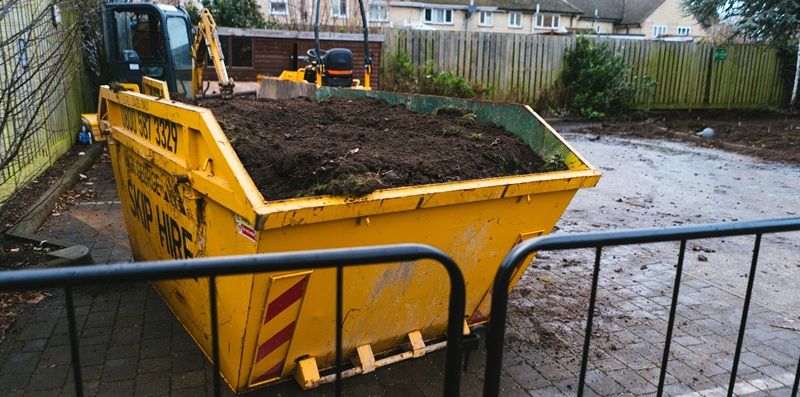
In London, where waste goes after collection is part of the cost. For example, skip hire provider easySkip points out that the material whose tax more than doubled in April is also the one parts of London are short of room for: planning evidence for the East London boroughs forecasts a shortfall in capacity for excavation waste of around 172,000 tonnes a year from 2025, rising to around 923,500 tonnes by 2041. The Greater London Authority’s London Plan aims for the equivalent of all of London’s waste to be managed within the capital by 2026, a target known as net self-sufficiency. Most skip hire firms, though, quote a single price for delivery, collection and disposal, so a London business rarely sees how far its waste travels, or how much of it reaches landfill.
The City of London’s own evidence shows what that looks like in practice: around 93,600 tonnes of construction, demolition and excavation waste from the Square Mile was deposited outside it in 2022, mostly in Havering, Enfield and Essex. The draft replacement London Plan, out for consultation until 15 October, keeps the borough-by-borough apportionment of waste that sits behind the 2026 target.
The rubble rate doubled by design
The 113.6 per cent figure is accurate and misleading at the same time.
According to HMRC’s published rates, the standard rate went from £126.15 to £130.75 a tonne on 1 April, and the lower rate from £4.05 to £8.65. Both rose by exactly £4.60. In cash terms, the tax on a tonne of rubble went up by the same amount as the tax on a tonne of mixed waste. It only looks dramatic as a percentage because the lower rate started from such a small base.
That was deliberate. The government had consulted on merging the two rates into a single rate by 2030. Its response to the consultation, published alongside last November’s Budget, concluded that now is not the right time, citing the potential impact on sectors including housebuilding and infrastructure. Instead, it said it would increase the lower rate in line with the cash increase of the standard rate, to prevent the gap between the two getting any wider.
The figure that matters is £122 a tonne
For a business deciding how to handle its waste, the useful number is neither rate. It is the gap between them.
That gap was £122.10 a tonne before April and it is £122.10 a tonne now. The ratio between the two rates has fallen from roughly 31 to one to roughly 15 to one, but the cash difference has not moved, and the stated policy is to keep it there.
The gap only helps a business whose waste can qualify for the lower rate, and HMRC’s general guide to the tax is blunt about mixed loads. Where a disposal contains both standard rated and lower rated material, tax is due on the whole load at the standard rate. A small amount of standard rated material in an essentially inert load can be disregarded. A container of brick and concrete with timber, packaging and general site waste thrown on top is not that.
So the decision that moves money is made on site, long before any Budget, when someone chooses whether rubble goes into its own container or into the general one.
What to look for on 28 October
Three things in the Budget documents are worth reading, even for a business that never reads tax tables.
The first is whether rates for April 2027 are announced at all. HMRC’s published table currently stops at April 2026, and last year’s figures were confirmed on Budget day.
The second is whether the lower rate rises by the same cash amount as the standard rate, as last November’s policy says it should. If it does, the percentage on rubble will look alarming again. To illustrate the arithmetic rather than predict the figure, a rise of £5 a tonne would add under 4 per cent to the standard rate and nearly 58 per cent to the lower rate.
The third is anything that reopens the policy itself. A return to the idea of a single rate would change the economics of separating waste far more than any annual uprating.
What to do before then
Most of the useful action does not depend on what the Chancellor says.
Separate inert waste wherever a job produces enough of it to justify a container of its own. Ask whether a load of clean rubble is priced differently from a general load, rather than assuming it is or is not. In London, also ask where clean rubble goes once it is collected: recycled close to the site, it avoids both the longer haul and the tax.
Check the dates on any quote for work that runs past 31 March 2027. A price agreed this autumn for a project finishing next spring may be revised once the new rates take effect.
And read the per tonne figures, not the percentages. The percentages on the lower rate will keep producing headlines. The cash gap is the number that decides the bill.
Landfill tax will not be the headline of this Budget. For a business with a refit or a building project in the next twelve months, it is one of the lines worth reading.
This article is in collaboration with easySkip