

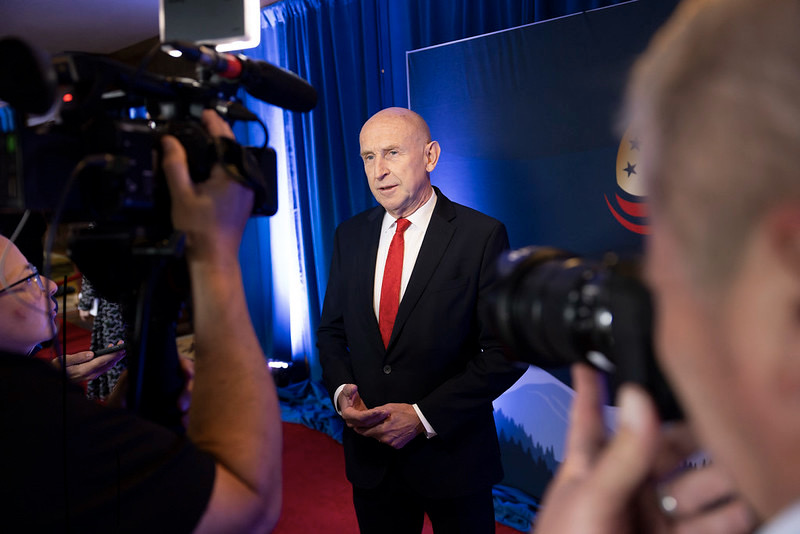
With a month to go until his first Budget as chancellor, John Healey has said the government will deliver “a new age of industrialisation”.
Speaking at the Labour Party Conference in Liverpool, Healey said ministers will “bring fresh hope to Britain, built on the rock of fiscal discipline, built on a growing economy, with good work and jobs in more places, built on a new age of industrialisation”.
He said the government will commit to £6 billion of contracts for British shipyards. “They’ll build the new docks for the new submarines that will defend us all for decades to come,” Healey added. “Built in Britain, by British workers because of decisions taken of this Labour government.”
The cost of business
Saying “we know how worried people are about..the cost of business”, the chancellor pledged to support companies with “policies to bring new levels of confidence, investment and…profits in British business”.
“It’s businesses that will create this country’s jobs, and wealth, and growth. And I say, growth isn’t just a graph or a spreadsheet. It’s a family at the kitchen table saying: yes, it looks like we can afford that holiday this summer. It’s the sole trader saying: yes, for the first time I think I can take on that apprentice.
“And it’s the community looking at its high street or its town centre and saying: there are new shops, there are new businesses, the pubs haven’t closed.”
Apprenticeships
Healey announced a new “local apprenticeships service”, with £100 million made available from the Department for Work and Pensions (DWP) budget for regional mayors to act “like football scouts for apprenticeships”.
He said: “Local teams who will go to local firms that’ve never taken on a trainee, and say: we’ll help you do it. That will go to the youngsters who’ve been out of work and say: we’ve got a place for you.
“Led by mayors, because it’s the mayor that knows their areas best. They know which firms are hiring, they know which colleges are delivering, and they know which estates have been left behind.”
Healey called it a “a downpayment on Alan Milburn’s work”. With almost one million young people not in education, employment or training (Neets) in the UK, the former health secretary was commissioned to investigate how youth unemployment can be tackled.
His interim report warned that the UK risks a “lost generation”, with young people being failed by a “broken system”. Milburn’s full recommendations will be published later this year.
The Budget
Healey hinted that difficult economic decisions will be part of the Budget on 28 October. He warned that the money New Labour had in the 90s is “simply not there now”, and criticised the Conservatives’ performance on the economy.
“The cost of the nation’s debt is not just a number in a chancellor’s Budget,” he said. “It’s the money that we can’t spend on the NHS, on schools, on housing, on social care. On policing our streets, on controlling our borders, on defending our country.
“And I tell you these levels of debt are an assault on our common sense, they are an affront to our values. And that’s why the prime minister and I are in lockstep that we will meet the fiscal rules. That we will maintain control of Britain’s finances.”
Prime minister Andy Burnham has previously refused to rule out tax rises in the Budget.
Reaction to John Healey’s Labour Party Conference speech
Shevaun Haviland, director general of the British Chambers of Commerce:
“This was a significant speech. The chancellor clearly recognised the importance of business in creating the UK’s wealth and that cutting their costs is key to achieving that.
“His pledge to use public procurement to back British capability also shows he understands its vital importance in driving regional growth.
“But smaller firms must be able to compete for contracts on a level playing field. The test now is whether new projects, such as the £6 billion for British shipyards, are delivered quickly, with clear pipelines that give businesses the confidence to invest in people and capacity.
“But this strategy is unlikely to succeed while the everyday cost of doing business is still soaring. Firms are being asked to invest while facing a tsunami of rising costs from employment, energy and business rates.
“For a typical SME their policy related operating costs have increased by more than 70% in 10 years. The Budget must give them breathing space, avoid any further tax rises and cut some of these costs.
“The chancellor rightly called out the deplorable situation where we have almost one million young people not in employment. The expansion of apprenticeships is welcome, but this will only be successful if the voice of business is heard.
“Local skills improvement plans have taught us this works best when employers are engaged through organisations such as Chambers.
“But he must go further on youth unemployment, a cut in employer National Insurance contributions for under-25s, will help firms create more opportunities for them.
“He should also consider reducing energy bills for firms, by cutting the Renewables Obligation by 75%, and lowering business rates multipliers.
“Reindustrialisation must be outward-looking. Consistent, locally delivered export support would help more SMEs reach new markets and turn British innovation into sustainable growth. And as AI transforms our economy, this new era must support the growth industries of the future.
“Alongside that, businesses need long-term certainty on skills, planning, infrastructure and a roadmap to reduce the tax burden.
“The chancellor should apply a growth delivery test to all of his budget decisions – will his measures prompt firms to do take positive action they would not otherwise have taken?”
Polly Dhaliwal, COO at Enterprise Nation:
“While we’re encouraged to see the chancellor put youth unemployment at the heart of his speech, which, set alongside the DWP’s Youth Jobs Grant, £3,000 for every eligible young person a firm takes on, makes it feel compelling.
“But a one-off grant won’t change the maths for most small businesses. Taking someone on has got significantly more expensive since the 2024 rise in employer national insurance, and that cost lands on top of an already growing pile of taxes and red tape. If the government wants small businesses to open their doors to young people, it needs to make hiring them cheaper and simpler, not just more generously subsidised.
“The founders of small businesses will now turn their eyes to the Budget. Today’s speech was big on ambition but lacked the practical measures that drive growth, especially for small businesses, who do the innovating and create the jobs. The chancellor has one more chance to give them a reason to hire.”
Tina McKenzie, national chair of Federation of Small Businesses:
“The chancellor was right to put the cost of doing business at the centre of his address today.
“The broad theme of hope needs to be followed up with concrete pro-business, pro-growth changes that help small businesses. As well as tax changes on costs, including fuel, late payment reforms must be fast-tracked and proposals for expanded regulation from Companies House should be turned around.
“It was encouraging to hear the chancellor talk about young people starting their own business as another important piece of the economic puzzle. It is crucial that the government also has a renewed focus on making it easier for employers to help take on young people, and we look forward to hearing more about plans for a local apprenticeship service.
“The government must be careful to support genuine self-employment and not allow measures to address so-called bogus self-employment to make it harder to become an entrepreneur in this country. Much like measures to tackle exploitative zero hours contracts, it should not inadvertently stop good two-way flexible working in the UK.
“The upcoming Budget will be the government’s opportunity to give small businesses breathing space. Raising the Small Business Rates Relief from £12,000 to £25,000 would do just that – removing 250,000 from paying rates and giving them room to expand and grow.
“We want to see reduced employment taxes on small firms and a Statutory Sick Pay rebate introduced for small employers, to mitigate against rising employment costs. Raising the VAT registration threshold to £100,000 and reversing the rise in business asset disposal relief would help business to invest, grow and employ.”
Michelle Ovens, CEO and founder of Small Business Britain:
“It’s encouraging to hear the chancellor’s focus on hope, local growth and creating opportunities for young people. Through our work on the Maple Review, we know how vital it is for young people to develop business skills throughout their education, and widening access to apprenticeships is just the start of this. Stronger collaboration between the public and private sectors will be vital to ensuring young people have the skills and confidence they need to thrive in the world of work.”
“We also welcome the chancellor’s confidence in British businesses and focus on a new age of industrialisation. Small businesses are integral to supply chains across the UK, and we look forward to seeing how investment in areas such as shipbuilding will create opportunities for SMEs and support local growth.
“With the Budget just a few weeks away, we hope this positive direction is followed by fiscal measures that give small businesses the support they need to start, grow and embrace new opportunities.”
Rain Newton-Smith, CBI chief executive:
“The chancellor’s speech set out a strong vision for how a politics of hope can translate into stronger business confidence and, ultimately, higher living standards.
“His commitment to fiscal discipline and recognition that it is a precondition for sustainable growth should provide reassurance to markets that the government is prepared to take difficult decisions to secure stable public finances.
“Just as important was the recognition that business needs breathing space. Firms cannot invest, hire and grow if rising costs continue to absorb the headroom they need to do so. By linking the cost pressures facing business to the wider challenge of raising living standards, the chancellor showed an appreciation that a stronger economy depends on giving firms the confidence and capacity to create jobs, raise wages and invest.
“There was also a welcome focus on using the tools available to government to get growth moving. Smarter procurement, apprenticeships shaped around local economic need, and greater use of institutions such as the National Wealth Fund can all help turn public spending into private investment, stronger supply chains and growth in communities across the country.
“The speech sent many of the right signals. The Budget now needs to turn them into action if we are to fundamentally change firms’ willingness to invest, take a chance on a young person, and scale a business here in the UK. That means delivering what the CBI has consistently called for, including bearing down on the cost of doing business, protecting the foundations for long-term investment, and removing the planning, infrastructure and regulatory barriers that hold back growth.”