
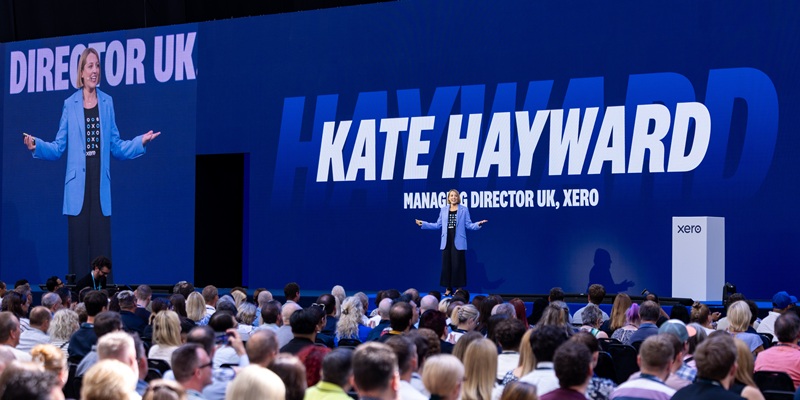
At Xerocon, the annual event in London for accountants, bookkeepers and small business advisers from accounting software company Xero, SMEWeb editor Dan Martin met Kate Hayward, the company’s UK managing director.
They discussed a range of subjects relevant to small businesses, including the introduction of Making Tax Digital for Income Tax, tackling the persistent problem of late payment, why the UK’s financial literacy levels need to be boosted, the impact of AI and how Kate’s self-employed father influenced her career.
You’ve been at Xero for seven years. What challenges have small businesses faced during that time?
The overall theme is that small businesses often need help. Small businesses are often overlooked. If you think about all sorts of issues, whether it’s software, whether it’s policy, whether it’s support, it’s often either for consumers or big businesses, and you have this group of small businesses in the middle. I think the issues that they have faced have changed. During COVID, a lot of them went into panic. And interestingly, who actually heard from them? It was accountants and bookkeepers as the first port of call.
Now they’re facing a lot of pressure on their cash flow and margins from increased business rates and other costs.
Do you think the challenges have got worse since the pandemic?
Our Xero small business index shows that it has been harder in some regards. From a growth perspective, it has slowed down. Specific sectors that had their own unique issues, such as pubs and hospitality. One of our customers who owns a coffee shop said at the end of the day, there’s a limit for how much someone’s going to pay for a coffee but her margins are being pressed and pressed with all the cost increases.
Late payment of invoices is a persistent issue for small businesses. What do you think of the new legislation that government is introducing to tackle it?
Late payment is unapproved debt, and it needs to stop. One of most common things we hear from small businesses is that cash flow is hard. Before getting on stage at Xerocon, a makeup artist did my makeup. I talked to her about cash flow. She’s brilliant at what she does, but she said she often doesn’t get paid until three to four months after a job. I think the legislation is for exactly those type of people who have done the work and deserve their money. I’m happy that the government is finally legislating on it. It’s a great first step, and we want to support in whatever way we can.
How is Xero helping the government to improve support for small businesses?
Our purpose is to make life easier for small businesses. We hear three key things from them. The first is they don’t want to end up in jail for getting their compliance wrong. The second is they’re worried about their cash flow and the third is access to capital.
We act as a convening function and give Xero small business index data to government and to others. We have 1.3 million small business customers, and we can see what’s happening.
We also bring the voice of small businesses, accountants and bookkeepers. We were at Number 10 recently and discussed e-invoicing which is going to be mandated in 2029. We wanted to make sure that government listened to the people that will have to bring it to life for small businesses.
Financial literacy is a big personal passion for you. Tell me more about that.
Two in five small businesses don’t know if they were profitable last month. We are a nation of small businesses, and yet we have a stigma that we’re not numbers people. But how can you not be a numbers person when you run a small business? Accountants and bookkeepers do a brilliant job at helping them, but there is a role for every single person, regardless of whether they’re a small business owner or end up in a corporate, to have a base knowledge of finances, and business finances specifically.
We’ve been working with Small Business Britain on the Maple Review. There are pockets of people from disadvantaged backgrounds where this shows up a lot worse. It should be a universal right that every child in secondary school gets financial literacy education.
Financial literacy will also help more people start businesses, such as women who currently only set up one in five companies in the UK. Everyone has right to start a business. There are some great ideas out there, and I think if more had the confidence and there was more education, we’d get a lot more entrepreneurs in the UK which would be brilliant for our economy and communities.

How has your dad being self-employed influenced your career?
My dad dropped out of school at 14 and became a carpenter who had to deal with the ups and downs of cash flow. I remember our accountant Terry coming to see mum and dad once a month. They always had fear about the money. I also remember coming home from a week’s holiday in Camber Sands and dad had lost his work for the next couple of weeks.
It taught me that I wanted stability and I think that’s what led to me becoming an accountant.
His experiences still influence me now in being passionate about other people having opportunities and it doesn’t matter where you come from. I now operate in circles that I didn’t even know existed growing up. If I can do it, anyone can do it. Your background shouldn’t stop you getting to where you want to be, whether that’s entrepreneurship or being in a corporate.
The first Making Tax Digital for Income Tax payment is due on 7 August but the latest figures show [this interview took place on 9 July 2026] that only around 350,000 of the 846,000 those impacted have registered. What are your thoughts?
I’m not surprised about the Making Tax Digital take up. I think accountants and bookkeepers will mass provide the bulk uploading of many of their businesses. Also, many small businesses are maybe waiting until they need to submit an update, and we will have a flow through.
Overall, there has been a huge increase in education and awareness. The optimist in me is really excited that those same people that I talked about who don’t know if they were profitable last month will now have a view of what their business looks like every quarter, and won’t have to work it all out once a year.
How is AI changing the way small businesses manage their finances?
AI drives the automation of jobs that small businesses don’t necessarily want to do, but are really important for their business. Take the example of people with heaps of receipts and invoices. Imagine a world where you can snap a picture, AI reads them and you get a real-time view. Plus, it’s linked to your bank account.
There are lots of examples of work that can be automated and help give better visibility to busy small businesses and their accountants and bookkeepers.
But what about the fear that some people feel about AI taking their jobs?
I stood on stage at Xerocon and said AI is coming for accountants, and I’m paying no heed to the scaremongering. And why? Because there are jobs that will be automated through AI, but I think the overall growth what an accountant can offer to a small business only grows.
We’ve always said that we want to democratise what big corporates have had in the finance function. Imagine an outsourced CFO for every single small business in the country. That could exist because you’re not spending time on the manual work that AI could do. So rather than thinking about AI taking my job, think about the growth of that job. So yes the role will change in the next three years, and your team will be spending time doing different things, but the prize will grow for everyone.
What are your key tips for how small businesses can manage their cash flow?
Understand the difference between revenue, costs and the timing of them for when the cash happens.
Use tools to chase payments. A lot of small businesses we talk to don’t follow up on getting paid, but using tools you can automate the chasing.
Speak to an accountant or bookkeeper if you’re stuck because they will give you a lot of advice about your business. They can help you think about which bits are profitable, which bits are not profitable and the overall health of your business.