


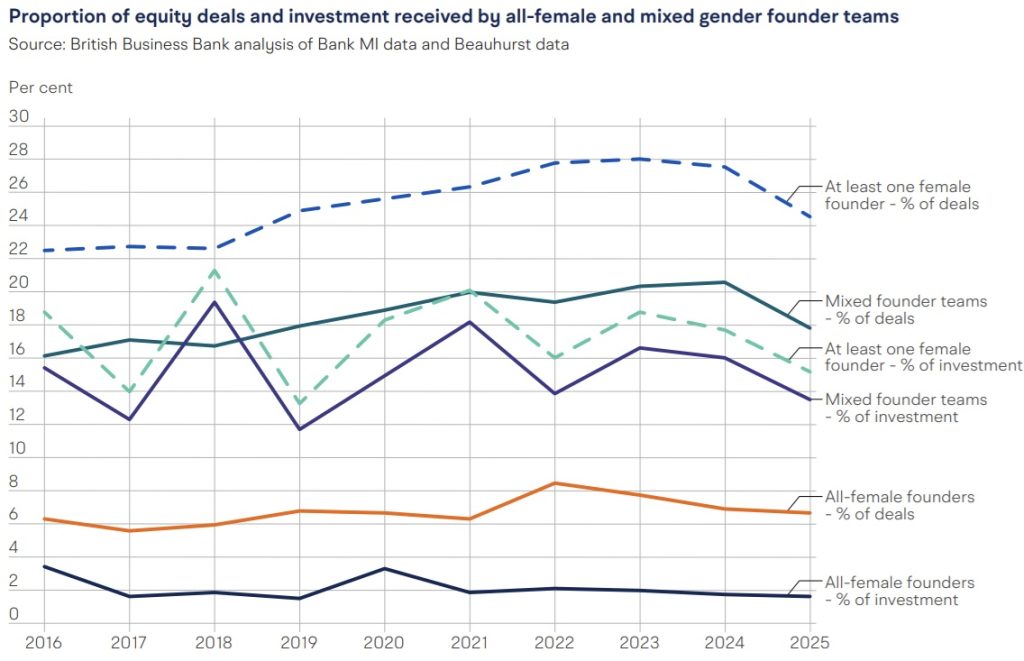
The share of equity investment going to all female-founded businesses remained at 2% in 2025, the same as the average across the last decade.
All-female founder teams also raised only 7% of UK equity deals, again the same figure for the past 10 years, according to the report by British Business Bank.
Other data showed the proportion of deals raised by teams comprising at least one female founding entrepreneur was 25% in 2025, down 3% on 2024.
The share of investment value captured by these teams also decreased from 18% to 15%.
The study showed that a record 44% of all UK equity investment into smaller businesses went to AI companies last year, driven by several large “mega deals”.
It warned that the “increasing prevalence of large equity deals among AI companies in 2025 are exacerbating these trends on a value basis”.
Of all AI-related deals above £10 million since 2021, only one has involved companies founded by all-female teams.
Just 3% of AI deals went to all-female founder teams, lower that the cross-sector average of 7% and even lower than the average for deals relating to technology/IP-based businesses (5%).
The gender of investors is also an issue, with the report saying the underrepresentation of female decision-makers in the venture capital industry is “highly pronounced” among those backing AI-related deals.
Recent research looking at UK trends between 2012 and 2022 found that VC firms with equal or majority representation of women at the decision-maker level made up only 4.5% of all those who invested in AI and accounted for an even smaller share of total capital invested (3.4%).
The imbalance is also shown by data on the gender breakdown of investors claiming tax relief under EIS and SEIS.
Over tax years 2022-23 to 2024-25, female investors accounted for 19% of EIS claims and 14% of the value of those claims. For SEIS, it was 18% of claims and 14% of claim value.
In other findings, female‑founder teams raised much smaller deals on average, with all-male teams consistently raising rounds that were around four times larger. Women teams were also less likely to secure follow‑on funding than all‑male and mixed‑gender teams.
Following their first funding round, only 43% of female founder teams went on to raise a subsequent round, compared with 51% of all-male teams and 57% of mixed gender teams.
Boosting funding for female entrepreneurs
The persistent lack of progress in female representation among equity-backed companies comes despite several efforts to tackle it. Examples are the Investing in Women Code which aims to tackle gender funding disparities in financial services.
The Invest in Women Taskforce, which was set up in 2024 to boost the amount of finance going to female entrepreneurs, is setting up funding schemes, including the £130m ‘Women backing Women Fund of Funds’.
A report by the Women and Equalities Committee last year said female entrepreneurs face “significant disadvantages in accessing finance, networks and support due to systemic bias, a lack of diversity among investment decision-makers and entrenched cultural norms.
The Rose Review of female entrepreneurship, led by former Natwest Group CEO Alison Rose, said £250 billion could be added to the UK economy if women started and scaled businesses at the same rate as men.
Related content
- International Women’s Day: 38 female founders share tips for business success
- Five female entrepreneurs share their success stories